
Skip to content
Titanium · Osseointegrated · Straumann · Nobel Biocare

Dental Implants in Turkey — Premium Brand Titanium Tooth Replacement at Eyeglow Istanbul

Single or multiple dental implants — titanium screws that biologically integrate with your jawbone over 3 to 6 months, supporting a custom zirconia crown that looks and functions like a natural tooth. Delivered at our partner accredited dental clinic by a DDS board-certified dental specialist using Straumann, Nobel Biocare, Astra Tech or Mega Gen implants with full manufacturer warranty documentation.
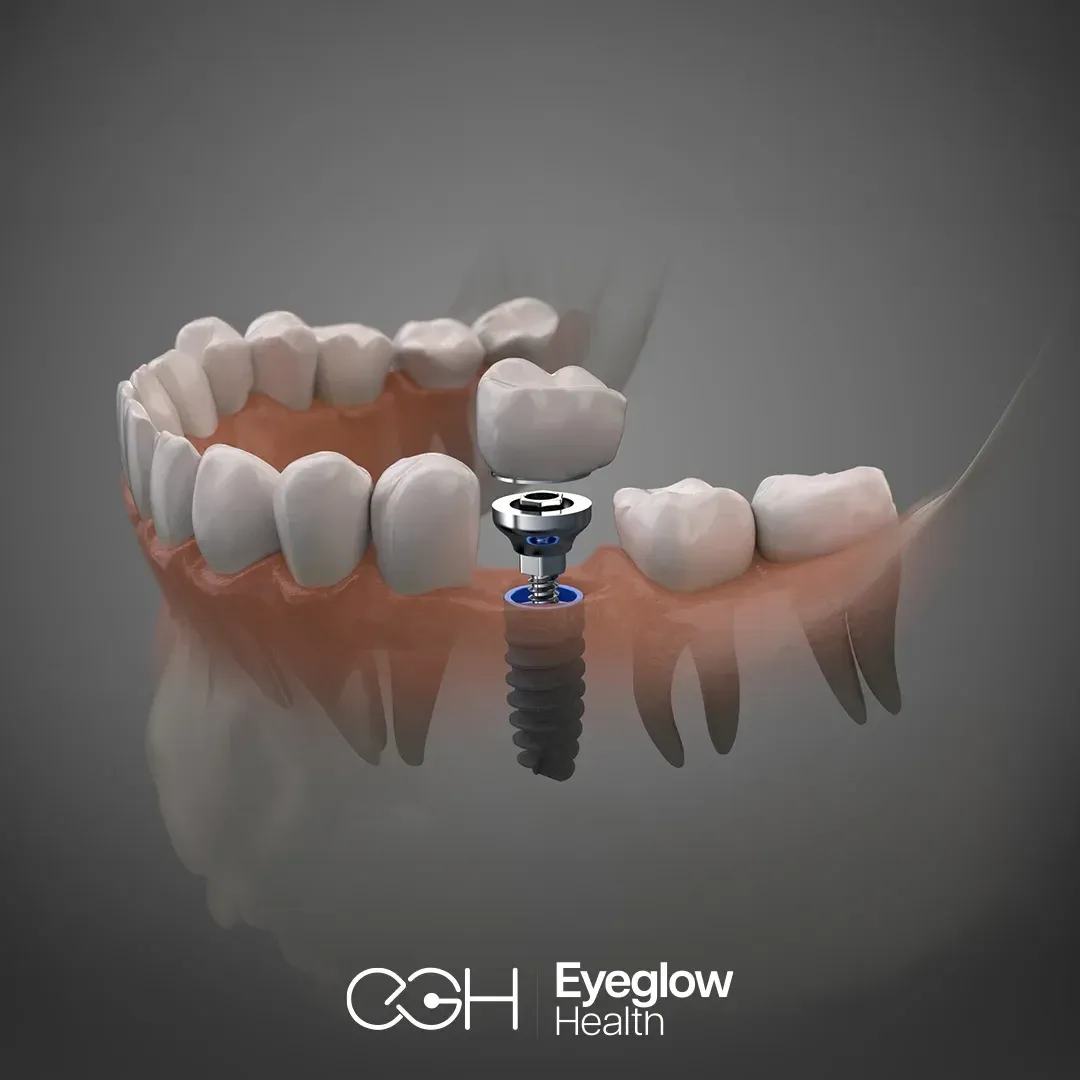
Dental implants at Eyeglow, Istanbul
Procedure time45–90 min per implant
AnaesthesiaLocal + optional sedation
Implant brandsStraumann · Nobel · Astra · Mega Gen
Healing (osseointegration)3–6 months
Time in Istanbul3–5 nights (per stage)
Implant lifespan20+ years (often lifetime)
What it is

What are dental implants?

A dental implant is a titanium screw surgically placed into the jawbone to replace the root of a missing tooth. Over 3 to 6 months it fuses with bone (osseointegration); a custom crown is then bonded onto an abutment connected to the implant. The result looks, feels and functions like a natural tooth — typically for 20 or more years.

At Eyeglow Health in Istanbul, dental implants are placed at our partner accredited dental clinic by a DDS board-certified dental specialist using original-component Straumann (Switzerland), Nobel Biocare (Sweden), Astra Tech (Sweden) or Mega Gen (Korea) implants — the same brands used in implant clinics across Zurich, London and Munich. The Turkish Ministry of Health International Health Tourism Authority Certificate is held by both Eyeglow and the partner dental clinic. We follow American Dental Association (ADA) and FDI World Dental Federation guidelines on implant placement, planning and informed consent.

Dental implants are the international standard of care for replacing single missing teeth — they preserve jawbone volume, do not damage adjacent natural teeth and typically outlast bridges and dentures by decades. The decision between implant, bridge or denture belongs to a DDS who has personally examined your mouth and reviewed your CBCT — not to a marketing brochure or a price-list page.

How it works

From first consultation to final crown

  1. 01

    Online consultation + CBCT review

    You share a panoramic X-ray or 3D cone-beam CT (CBCT) plus a brief dental history. Our partner DDS reviews bone volume in the implant site, identifies whether a bone graft or sinus lift is needed, and selects the appropriate implant brand and dimensions. A written treatment plan with itemised pricing is sent before any payment is requested.

  2. 02

    Pre-operative assessment in Istanbul

    On day 1: clinical examination, periodontal screening, fresh CBCT if needed, blood tests (CBC, INR, hepatitis B/C, HIV per Turkish Ministry of Health protocol) and informed consent. The implant site is planned digitally with implant-planning software so the surgical guide can be prepared.

  3. 03

    Implant placement (45–90 min per implant)

    Under local anaesthetic (optional intravenous sedation), the gum is opened, a precision osteotomy is drilled into the jawbone using the surgical guide, and the titanium implant is screwed into the prepared site at controlled torque. A healing abutment or cover screw is placed. The gum is sutured. Most single implants take 45 to 60 minutes; multiple implants are placed in the same session.

  4. 04

    Healing + osseointegration (3 to 6 months)

    You return home with antibiotics, anti-inflammatories and oral-rinse instructions. During this period the titanium implant fuses biologically with the surrounding bone — a process called osseointegration first described by Brånemark in the 1960s. A temporary tooth (flipper or bonded bridge) covers the gap if the implant is in a visible zone.

  5. 05

    Abutment connection + impression (visit 2)

    You return to Istanbul after osseointegration is confirmed by CBCT or torque test. The healing abutment is removed, the permanent abutment is connected, and a digital scan or physical impression is taken. The final crown is fabricated in zirconia or porcelain-fused-to-metal in the partner dental laboratory.

  6. 06

    Final crown delivery + structured aftercare

    The final crown is bonded or screw-retained onto the abutment. Bite is checked and adjusted. Hygiene instructions specific to implant maintenance are provided (interdental brushes, water flosser, professional cleaning every 6 months). Eyeglow coordinator provides 3, 6 and 12-month photographic reviews and long-term implant warranty documentation.

Tooth replacement options

Dental implant vs bridge vs denture vs no treatment

The right tooth-replacement option depends on how many teeth are missing, your jawbone volume, your long-term priorities and your budget. Here is how the four main paths compare:

AspectImplantBridgeDentureDo nothing
Lifespan20+ years (often lifetime)10–15 years5–8 years (relines needed)Bone resorption continues
Bone preservationStimulates bone (prevents resorption)No bone stimulationNo bone stimulationBone loss accelerates
Adjacent teethUntouchedAdjacent teeth filed downClasps may stress teethAdjacent teeth may shift
Function (chewing)Near-natural (90%+ bite force)Good (~70% bite force)Reduced (~30% bite force)Compromised
MaintenanceLike natural tooth (brush + floss)Special floss under bridgeRemove + clean nightlyN/A
Total procedure time3–6 months (osseointegration)2–3 weeks2–4 weeksNone
Pricing

Personalised pricing

Every treatment plan is priced individually after your consultation. Request a written, all-inclusive quote — clear, itemised, and with no obligation.

Request a written quote
Package transparency

What's included in your dental implant package

Included in package

  • Pre-op consultation + clinical examination + CBCT review
  • Implant-planning software analysis + surgical guide where indicated
  • Blood tests (CBC, INR, hepatitis B/C, HIV — Turkish Ministry of Health protocol)
  • Implant placement at partner accredited dental clinic by DDS board-certified dental specialist
  • Local anaesthetic (intravenous sedation available on request)
  • Healing abutment + temporary tooth in visible zones
  • 5-star hotel — 3 nights per stage (typically 2 stages)
  • VIP airport transfers (return) for both visits
  • All post-op medications + antibiotics + oral-rinse + aftercare kit
  • Final zirconia or porcelain-fused-to-metal crown + abutment
  • 3, 6 and 12-month photographic video follow-up
  • Implant manufacturer warranty documentation (Straumann lifetime, Nobel Biocare 10-year, Mega Gen lifetime)
  • Multilingual dental coordinator — 24/7
  • Complication insurance — covers eligible post-operative medical complications during the recovery period at our partner accredited clinic (issued in line with the Turkish Ministry of Health International Health Tourism Authority Certificate)

Paid separately

Items below are not part of the medical package — your coordinator helps you arrange them at no markup.

  • Flights to/from Istanbul (two visits typically required)
  • Personal expenses
  • Optional intravenous sedation upgrade (quoted separately if requested)
  • Unrelated dental treatments (whitening, additional crowns, root canals on other teeth)
  • Treatment of pre-existing periodontal disease (a separate gum-treatment plan is provided if needed)
  • Travel insurance (flight cancellation, baggage, general trip cover) — separate from the medical complication policy above; your coordinator can recommend a provider at no markup
Candidacy

Are you a candidate for dental implants?

You may be a good candidate if

  • You have one or more missing teeth and adequate jawbone volume (or are willing to undergo a bone graft / sinus lift to build the site).
  • Your gums are healthy or any periodontal disease is under stable control before implant surgery.
  • You are a non-smoker or willing to stop smoking from 2 weeks before surgery to 3 months after — nicotine reduces osseointegration success.
  • You can commit to two visits to Istanbul (3–5 nights each) separated by 3 to 6 months of healing.
  • You understand the procedure timeline is months, not days — the final crown is delivered only after biological bone integration is confirmed.

A bridge or denture may be a wiser first step if

  • You have uncontrolled diabetes (HbA1c above 8%), untreated periodontal disease or active oral infection — these must be stabilised first.
  • You are taking high-dose intravenous bisphosphonates (osteoporosis medication) — osteonecrosis risk is elevated; a bridge or denture may be safer.
  • You have had radiotherapy to the jaw within the last 12 months — implant healing is impaired in irradiated bone.
  • You are unable to maintain meticulous daily oral hygiene — peri-implantitis risk is significantly increased.
  • You want a same-week solution — a single tooth implant from start to finish takes 3 to 6 months minimum; if you need teeth fast consider All-on-4 or an immediate bridge.

Disclaimer. Information on this page is consistent with American Dental Association (ADA) implant guidelines, FDI World Dental Federation standards and Turkish Ministry of Health International Health Tourism Authority Certificate requirements. Dental implant candidacy is a clinical decision based on bone volume, periodontal status, medical history and patient priorities — not a marketing-driven default.

Risks & outcomes

Realistic outcomes — the risks that actually matter

Every dental implant procedure has measurable risks. We list them here in the same plain language our DDS uses in your consultation:

Osseointegration failure

Implants fail to integrate with bone in approximately 2 to 5% of cases (higher in smokers, diabetics and irradiated bone). When failure occurs, the implant is removed, the site is allowed to heal for 3 to 6 months, and a replacement implant is placed (usually one size larger) at no implant-component cost under our warranty. Eyeglow coordinator manages return travel logistics for warranty cases.

Peri-implantitis (long-term)

Bacterial infection around the implant — analogous to gum disease around a natural tooth — affects roughly 10 to 20% of implants over a 10-year period if oral hygiene is poor. Symptoms: bleeding gums, deep pocketing around the implant, eventual bone loss. Prevention: daily interdental brushing, professional cleaning every 6 months. Early treatment with mechanical debridement and antimicrobial therapy is highly effective; late peri-implantitis may require implant removal.

Nerve injury (lower jaw implants)

The inferior alveolar nerve runs through the lower jaw and supplies sensation to the lip and chin. Implants placed too close can cause temporary or permanent numbness (paraesthesia). CBCT planning and surgical guide use reduce this risk to under 1%. We perform 3D digital planning on every lower posterior implant.

Sinus complications (upper back jaw)

Upper back jaw implants may perforate the maxillary sinus floor, causing sinusitis or implant loss. When bone height is under 6 mm a sinus lift procedure is performed first. CBCT is mandatory before any upper back jaw implant — we do not place implants based on 2D panoramic X-ray alone.

FAQ

Frequently asked questions about dental implants

What are dental implants?

A dental implant is a small titanium (or occasionally zirconia) screw that is surgically placed into the jawbone to replace the root of a missing tooth. Over a healing period of 3 to 6 months the implant fuses biologically with surrounding bone — a process called osseointegration, first described by the Swedish researcher Per-Ingvar Brånemark in 1965. Once integration is confirmed, an abutment (connector) is fitted onto the upper end of the implant, and a custom-made crown is bonded or screwed onto the abutment. The final result looks, feels and functions like a natural tooth and typically lasts 20 or more years with proper care. Dental implants are the international standard of care for single tooth replacement endorsed by the American Dental Association (ADA), the FDI World Dental Federation and the European Association for Osseointegration.

How is a dental implant priced in Turkey?

Dental implant pricing in Turkey depends on the implant brand selected (Straumann, Nobel Biocare, Astra Tech or Mega Gen), whether a bone graft or sinus lift is needed, and how many implants are placed in one session. Because these factors vary significantly between patients, Eyeglow Health provides a personalised written quote after reviewing your CBCT and dental history — before any payment is requested. The quote is fully itemised (implant fixture, abutment, crown, hotel, transfers, complication insurance) so you can compare it transparently. Request a written, all-inclusive quote via the form on this page.

How long do dental implants last?

Modern titanium dental implants have a documented 10-year success rate of 95 to 98% in healthy non-smoker patients, based on long-term clinical studies (Pjetursson 2012, Moraschini 2015). With proper oral hygiene many implants last 20 to 30 years; lifetime survival is realistic. The implant fixture itself (the titanium screw in the bone) typically outlives the crown that sits above it — crowns may need replacement every 10 to 15 years due to wear or aesthetic ageing. Premium brands such as Straumann offer lifetime warranty on the implant fixture; mid-tier brands typically offer 10-year warranty. The biggest threat to long-term implant survival is peri-implantitis (gum infection around the implant), which is highly preventable with daily interdental brushing and 6-monthly professional cleaning.

Are dental implants safe?

Titanium dental implants have a documented safety record spanning more than 50 years and are approved by the United States Food and Drug Administration (FDA), the European Medicines Agency (EMA) and equivalent regulatory bodies worldwide. Titanium is the same biocompatible metal used in orthopaedic joint replacements and pacemaker leads — true titanium allergy is extraordinarily rare (under 0.6% in published series). The procedure itself is performed under local anaesthetic and has a complication rate comparable to having a wisdom tooth extracted. The most important safety factor is the experience of the operating DDS and the diagnostic accuracy of CBCT-based 3D planning — both of which are standard at our partner accredited dental clinic. The American Dental Association classifies implants as the international standard of care for single tooth replacement.

Do dental implants hurt?

The implant placement itself is performed under local anaesthetic and is generally not painful — most patients compare the sensation to a standard tooth extraction. After the anaesthetic wears off, mild to moderate discomfort for 2 to 5 days is typical and is usually well controlled with over-the-counter pain relievers (paracetamol, ibuprofen). Swelling and bruising peak at 48 to 72 hours and resolve within a week. Intravenous sedation is available on request for anxious patients (quoted separately as an upgrade). Long-term, once the implant has integrated and the crown is fitted, the implant is not painful in any way — it has no nerve and cannot feel hot, cold or chewing pressure (although you will feel pressure through the surrounding gum and bone).

What brand of dental implant do you use?

Eyeglow Health partner clinic offers four implant brand tiers based on your budget, anatomy and long-term priorities. Straumann (Switzerland) — premium tier with SLActive surface for the fastest osseointegration; lifetime warranty; the most-published implant brand worldwide. Nobel Biocare (Sweden) — premium tier; pioneers of the original Brånemark implant; 10-year warranty; the original All-on-4 system manufacturer. Astra Tech / Dentsply Sirona (Sweden) — premium tier; OsseoSpeed surface; excellent for thin-bone cases. Mega Gen (South Korea) — high mid-tier; AnyRidge implant; FDA approved; lifetime warranty; excellent value for cost-sensitive patients. The brand recommendation is made by your DDS based on your bone quality, smoking history, aesthetic site and 20-year outlook — not on what is most profitable for the clinic.

How long is the dental implant procedure and how many visits do I need to Turkey?

A single dental implant from start to finish takes 3 to 6 months and typically requires two visits to Istanbul. Visit 1 (3 to 5 nights): implant placement surgery, with same-day temporary tooth in visible zones. You return home for 3 to 6 months of osseointegration healing. Visit 2 (3 to 5 nights): abutment connection, impression scan, final crown try-in and crown delivery. If a bone graft or sinus lift is required first, a third visit may be needed, adding 4 to 6 months to the overall timeline. Some immediate-load protocols allow the temporary crown to be fitted on the day of implant placement; this is decided case-by-case based on primary stability measured at surgery. Your coordinator manages flight and hotel scheduling so the two visits align with implant-ready milestones.

Will I need a bone graft or sinus lift?

Bone grafting is needed when there is insufficient bone volume to anchor the implant — typically because the tooth was lost many years ago and the surrounding bone has resorbed away. Approximately 30 to 40% of implant cases require some form of bone augmentation. Small grafts can be done at the same time as implant placement (delayed implant loading); large grafts require a separate procedure 3 to 6 months before implant placement. Sinus lift specifically applies to upper back jaw implants where the maxillary sinus floor needs to be raised to create vertical bone space. Your need for bone augmentation is determined from the CBCT scan reviewed at consultation — you receive a transparent written quote that includes bone graft or sinus lift if indicated, before any payment is requested.

What is the difference between a dental implant and a bridge?

A dental implant replaces both the root and the crown of a missing tooth — the titanium fixture in the bone acts as the artificial root, the crown above it acts as the visible tooth. A dental bridge replaces only the visible crown and is anchored by cementing onto the two adjacent natural teeth, which must be filed down to receive the bridge framework. Key differences: (a) Bone preservation — implants stimulate the underlying jawbone and prevent the resorption that occurs after tooth loss; bridges do not. (b) Adjacent teeth — implants leave neighbouring teeth untouched; bridges require sacrificial preparation of healthy adjacent teeth. (c) Lifespan — implants typically last 20 or more years; bridges 10 to 15 years. (d) Investment — implants require higher upfront investment but lower long-term cost because they do not require replacement of adjacent crowns; bridges cost less upfront but need replacement every 10 to 15 years. For single-tooth replacement, implants are generally the long-term superior choice; bridges remain valid when adjacent teeth already require crowns. Request a written, all-inclusive quote for both options so you can compare them transparently.

Can I get all my teeth replaced with implants in one visit?

For full-arch replacement, the All-on-4 or All-on-6 fixed-bridge protocol allows a complete set of upper or lower teeth to be placed on 4 or 6 angled implants in a single same-day surgery — the temporary bridge is fitted within 24 hours ("teeth in a day"). The final zirconia bridge is fitted 3 to 6 months later after osseointegration. This is fundamentally different from placing individual implants for each missing tooth, which would take 3 to 6 months per implant. For patients missing most or all of their teeth, All-on-4 or All-on-6 is the practical full-mouth solution; for patients missing 1 to 3 teeth, individual implants are usually the right choice. See our All-on-4 and All-on-6 pages for full details on the same-day full-arch protocols.

Why choose Eyeglow Health for dental implants in Turkey?

At Eyeglow Health your dental implant treatment is performed at our partner accredited dental clinic by a DDS board-certified dental specialist. Both Eyeglow and the partner clinic hold the Turkish Ministry of Health International Health Tourism Authority Certificate. We are honest that Eyeglow is primarily an eye-care specialist clinic — dental treatments are delivered through our partner dental clinic network with full transparency, the same care coordination and the same complication insurance as our eye procedures. We use only original-component Straumann, Nobel Biocare, Astra Tech and Mega Gen implants with verifiable lot numbers and full manufacturer warranty documentation. One named coordinator from first message to 12-month follow-up; written treatment plan with itemised pricing before any payment; honest discussion of whether implant, bridge or denture is the right choice for your case.

What aftercare do dental implants need?

Implant maintenance is straightforward but lifelong. Daily: brush twice a day with a soft-bristle brush; use interdental brushes (TePe, Curaprox) or a water flosser around the implant — standard string floss is less effective around the implant collar. Every 6 months: professional dental hygiene appointment with a hygienist trained in implant maintenance (specialised plastic-tipped instruments are used to avoid scratching the implant surface). Avoid: smoking (significantly increases peri-implantitis risk), grinding without a night guard (mechanical overload can fracture the abutment screw), chewing very hard objects (ice cubes, pen caps). Eyeglow coordinator provides a written aftercare protocol in your language and is available for any concern at any time during the 12-month follow-up window.
Get a free quote