
Hair PRP & Mesotherapy in Turkey — Autologous Platelet-Rich Plasma Support at Eyeglow Istanbul
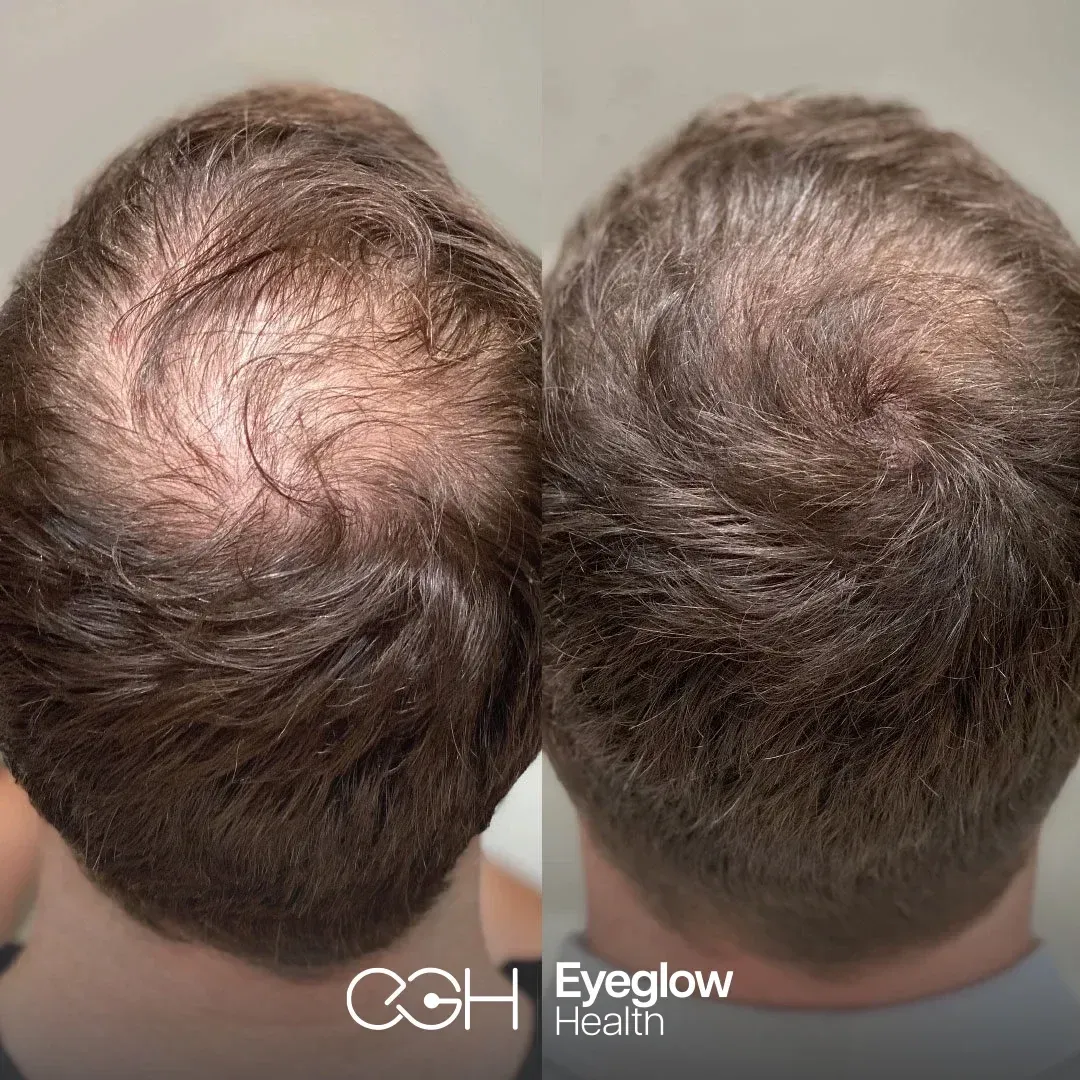
Hair PRP uses your own platelet-rich plasma, extracted from a small blood draw and microinjected into the scalp, to support early-stage androgenetic alopecia, telogen effluvium and post-transplant graft survival. Mesotherapy adds a vitamin, peptide and growth factor cocktail. A supportive treatment — not a replacement for hair transplant. Honest expectation: 10 to 20 percent density improvement in responders, no regrowth from dead follicles.
Verified and listed across leading directories and authorities


What is hair PRP and mesotherapy?
Hair PRP is a microinjection treatment where your own blood is drawn (15 to 30 ml), centrifuged to separate the platelet-rich plasma layer (containing 3 to 5 times the platelet concentration of whole blood plus growth factors PDGF, TGF-β, VEGF, EGF and IGF-1), and microinjected into the thinning zones of your scalp. Mesotherapy adds a vitamin, peptide and growth-factor cocktail (biotin, B-complex, copper peptides, hyaluronic acid) to the same injection. PRP is a supportive treatment for early-stage hair loss and post-transplant graft survival — NOT a replacement for hair transplant.
At Eyeglow Health in Istanbul, your PRP or mesotherapy session is performed at our partner accredited hair clinic by a hair restoration surgeon — not by a beautician or general practitioner. We use validated PRP system protocols with documented platelet concentration multiples, sterile centrifugation, and microinjection technique that distributes PRP evenly through the thinning zones. The Turkish Ministry of Health International Health Tourism Authority Certificate is held by both Eyeglow and the partner clinic.
PRP is the right treatment for early androgenetic alopecia (Norwood 2 to 3 in men, Ludwig 1 to 2 in women), telogen effluvium recovery, and post-transplant graft support. It is the wrong treatment for advanced hair loss (Norwood 5+), permanently bald scalp zones, and patients expecting transplant-level coverage from injections alone. We are explicit about this in consultation — if your hair loss stage makes a meaningful PRP response unlikely we recommend surgical transplant or medical therapy instead. Published response rate is 60 to 80 percent in carefully selected early cases, with a 10 to 20 percent density improvement ceiling in responders.
From blood draw to scalp microinjection
- 01
Online consultation + scalp assessment
You share four standardised photographs of your scalp (front hairline, crown, left and right sides) and explain your hair-loss history (onset, family pattern, current medications). Our hair surgeon reviews whether your hair loss is at a stage PRP can meaningfully help — early androgenetic alopecia, telogen effluvium, post-transplant graft support or female pattern hair loss in responders.
- 02
Blood draw and centrifugation
On treatment day, 15 to 30 ml of your own blood is drawn from your arm into anticoagulant-treated collection tubes — exactly like a routine blood test. The tubes are placed in a centrifuge spinning at 1,500 to 3,200 rpm for 8 to 15 minutes (depending on protocol), separating the blood into three layers: red cells at the bottom, platelet-rich plasma (PRP) in the middle, platelet-poor plasma at the top.
- 03
PRP extraction and activation
The platelet-rich plasma layer (typically 3 to 6 ml from the original 15 to 30 ml draw, with 3 to 5 times the platelet concentration of whole blood) is aspirated into a sterile syringe. For mesotherapy combination protocol, a vitamin/peptide/growth factor cocktail (biotin, B-vitamin complex, copper peptides, hyaluronic acid) is added to the syringe at this stage. Calcium chloride may be added as an activator depending on system protocol.
- 04
Microinjection into scalp
The PRP (or PRP + mesotherapy cocktail) is microinjected into the scalp at 0.1 ml per injection point, spaced 1 cm apart across the thinning zones (frontal hairline, mid-scalp, vertex). Total injection time 15 to 25 minutes. Topical numbing cream applied 30 minutes before reduces injection sensation; some patients still describe a sharp prickle, others feel only mild pressure. No general or local injection anaesthetic is needed.
- 05
Same-day return to activity
No crusts, no shedding, no visible downtime. Mild scalp tenderness for a few hours; occasional small pinpoint bruising at injection sites resolving within 3 to 5 days. Avoid washing the scalp for 4 hours; avoid intense exercise, sauna, swimming pool and alcohol for 24 to 48 hours (these increase scalp bleeding and reduce platelet retention).
- 06
Loading course + maintenance schedule
Standard protocol: 3 monthly sessions as a loading course (month 0, month 1, month 2), then maintenance every 4 months ongoing. First visible response appears at month 3 to 6 in responders — reduced shedding on the pillow and shower drain, modest density improvement in early-stage hair loss. Honest expectation: PRP slows progression and may improve density 10 to 20 percent; it does not regrow hair from dead follicles.
PRP vs FUE vs DHI vs Finasteride + Minoxidil
PRP is a supportive treatment; surgical transplant is a coverage treatment; finasteride + minoxidil is a long-term medical treatment. Here is how the four options compare on mechanism, outcome ceiling and time to result:
| Aspect | PRP / Mesotherapy | FUE Transplant | DHI Transplant | Finasteride + Minoxidil |
|---|---|---|---|---|
| Mechanism | Growth factors stimulate existing follicles | New follicles transplanted from donor | New follicles transplanted (Choi pen technique) | DHT-blocker + vasodilator slow progression |
| Best for | Early androgenetic alopecia (Norwood 2–3), post-transplant support | Established Norwood 3–6 needing real coverage | Medium dense-pack sessions, unshaven recipient | Anyone with active androgenetic alopecia |
| Outcome ceiling | 10–20% density boost in responders | Permanent coverage in transplanted zone | Permanent coverage with denser packing | Slows loss, modest regrowth on minoxidil |
| Regrows dead follicles | No | Adds new follicles (not regrowth) | Adds new follicles (not regrowth) | Minimal — slows progression mainly |
| Time to result | 3–6 months (in responders) | 12–18 months final result | 12–18 months final result | 6–12 months to stabilisation |
| Procedure type | Microinjection — same day return | Surgery — 6–9 hours, 7–10 day recovery | Surgery — 7–10 hours, 7–10 day recovery | Oral tablet + topical foam |
| Ongoing requirement | Maintenance sessions every 4 months after loading course | One-time procedure — no ongoing sessions | One-time procedure — no ongoing sessions | Daily oral/topical — indefinite |
Personalised pricing
Every treatment plan is priced individually after your consultation. Request a written, all-inclusive quote — clear, itemised, and with no obligation.
Request a written quoteWhat's included in your hair PRP package
Included in package
- Pre-treatment scalp examination + hair-loss stage assessment (Norwood / Ludwig scale)
- Hair surgeon-led decision on whether PRP is the right treatment for your case
- Blood draw (15 to 30 ml from arm) + centrifugation under sterile protocol
- PRP extraction + optional mesotherapy cocktail addition
- Topical numbing cream (applied 30 minutes pre-injection)
- Microinjection into thinning zones (frontal hairline, mid-scalp, vertex as needed)
- VIP airport transfers (return) on treatment-only visits
- Written aftercare protocol + activity restrictions for 24–48 hours
- Photographic baseline + 3-month and 6-month review
- Multilingual hair coordinator — 24/7 during the treatment period
Paid separately
Items below are not part of the medical package — your coordinator helps you arrange them at no markup.
- Flights to/from Istanbul
- Personal expenses
- Concurrent finasteride or minoxidil (prescribed at consultation if appropriate)
- Additional maintenance sessions beyond the loading course (quoted per session)
- Unrelated medical treatments
- Travel insurance (flight cancellation, baggage, general trip cover); your coordinator can recommend a provider at no markup
Are you a candidate for hair PRP?
You may be a good candidate if
- You have early-stage androgenetic alopecia (Norwood 2 to 3) and want to slow progression and modestly boost density without surgery.
- You had a hair transplant in the past 6 to 24 months and want PRP to enhance graft survival and support surrounding native hair.
- You have telogen effluvium (post-illness, post-pregnancy, post-stress diffuse shedding) and want to accelerate recovery once the underlying cause is resolved.
- You have female pattern hair loss (FPHL) at early Ludwig 1 to 2 stage — PRP responds better in women than in advanced male pattern loss.
- You accept the honest outcome ceiling — 10 to 20 percent density improvement in responders, no regrowth from dead follicles.
Another option may be smarter if
- You have advanced hair loss (Norwood 5 to 7 or Ludwig 3) and expect PRP to restore your hairline — surgical transplant is the only option that adds real coverage.
- You have an active scalp infection or untreated severe dandruff — must be treated before PRP injection.
- You have a bleeding disorder, are on therapeutic anticoagulants (warfarin, DOAC) or have a platelet count below 150,000 — PRP requires normal coagulation.
- You expect zero financial commitment beyond one session — single PRP rarely produces lasting benefit; loading course + maintenance is the realistic protocol.
Disclaimer. Information on this page is consistent with International Society of Hair Restoration Surgery (ISHRS) consensus on PRP for hair loss, American Hair Loss Association (AHLA) guidance and Turkish Ministry of Health International Health Tourism Authority Certificate requirements. PRP is a supportive treatment with a 60 to 80 percent response rate in carefully selected early-stage cases and a 10 to 20 percent density ceiling in responders. It does not regrow hair from dead follicles and is not a replacement for surgical hair transplant in established loss.
Realistic outcomes — the risks that actually matter
PRP is among the safer hair-loss treatments (autologous, no synthetic drug, no transfusion risk) but it has honest limitations. We list them here in the same plain language our hair surgeon uses in your consultation:
Non-response in 20 to 40 percent of patients
PRP is not a guaranteed treatment — published response rates range from 60 to 80 percent in carefully selected early-stage cases (Norwood 2 to 3, Ludwig 1 to 2). The remaining 20 to 40 percent show no measurable density improvement after a full loading course. Predictors of non-response: advanced hair loss stage, long-standing loss (>10 years), concurrent untreated medical causes (iron deficiency, thyroid disease), very low baseline platelet count. We assess response objectively at month 3 to 6 by standardised photography; if you are a non-responder we are honest and recommend stopping rather than continuing.
PRP does not regrow hair from dead follicles
PRP growth factors stimulate existing follicles — they cannot resurrect follicles that have already undergone permanent miniaturisation and fibrosis (the end stage of androgenetic alopecia, typically Norwood 5+). If your bald zone has been shiny and smooth for several years, PRP injected into that zone will produce no result, because there are no follicles to stimulate. Surgical transplant is the only treatment that adds new follicles to a permanently bald zone. We are explicit about this in consultation.
Mild bruising, tenderness and rare scalp infection
The most common side effects are mild scalp tenderness for a few hours and small pinpoint bruising at injection sites resolving within 3 to 5 days. Rare risks: scalp infection (1 in 500 to 1 in 1,000 sessions, treated with oral antibiotics), allergic reaction to the mesotherapy cocktail (if used), and very rarely a transient flare of telogen shedding from the injection-related inflammation (settles within 6 to 8 weeks). Because PRP is autologous (your own blood) there is no risk of transfusion-related disease or graft-versus-host complications.
Cost without proportional benefit if used in advanced loss
PRP is most cost-effective in early-stage hair loss where modest density improvement is meaningfully visible. In advanced loss (Norwood 5+) the same money spent on PRP would produce no visible result, while the same money spent on a hair transplant package gives permanent coverage. We refuse to sell PRP loading courses to patients whose hair loss stage makes a meaningful response unlikely. Honest gate-keeping is part of our role at consultation.