
Female Hair Transplant in Turkey — FUE & DHI for Women at Eyeglow Istanbul
FUE (sapphire blade, 0.7–0.8 mm punch) and DHI (Choi pen, unshaven option) for female pattern hair loss, androgenetic alopecia and temporal recession. Mandatory hormonal screening before surgery — PCOS, thyroid, ferritin and androgen profile assessed pre-operatively. Performed at our partner accredited hair clinic by a board-certified hair restoration surgeon. Written graft estimate and one year of structured photographic aftercare.
Verified and listed across leading directories and authorities


What is female hair transplant?
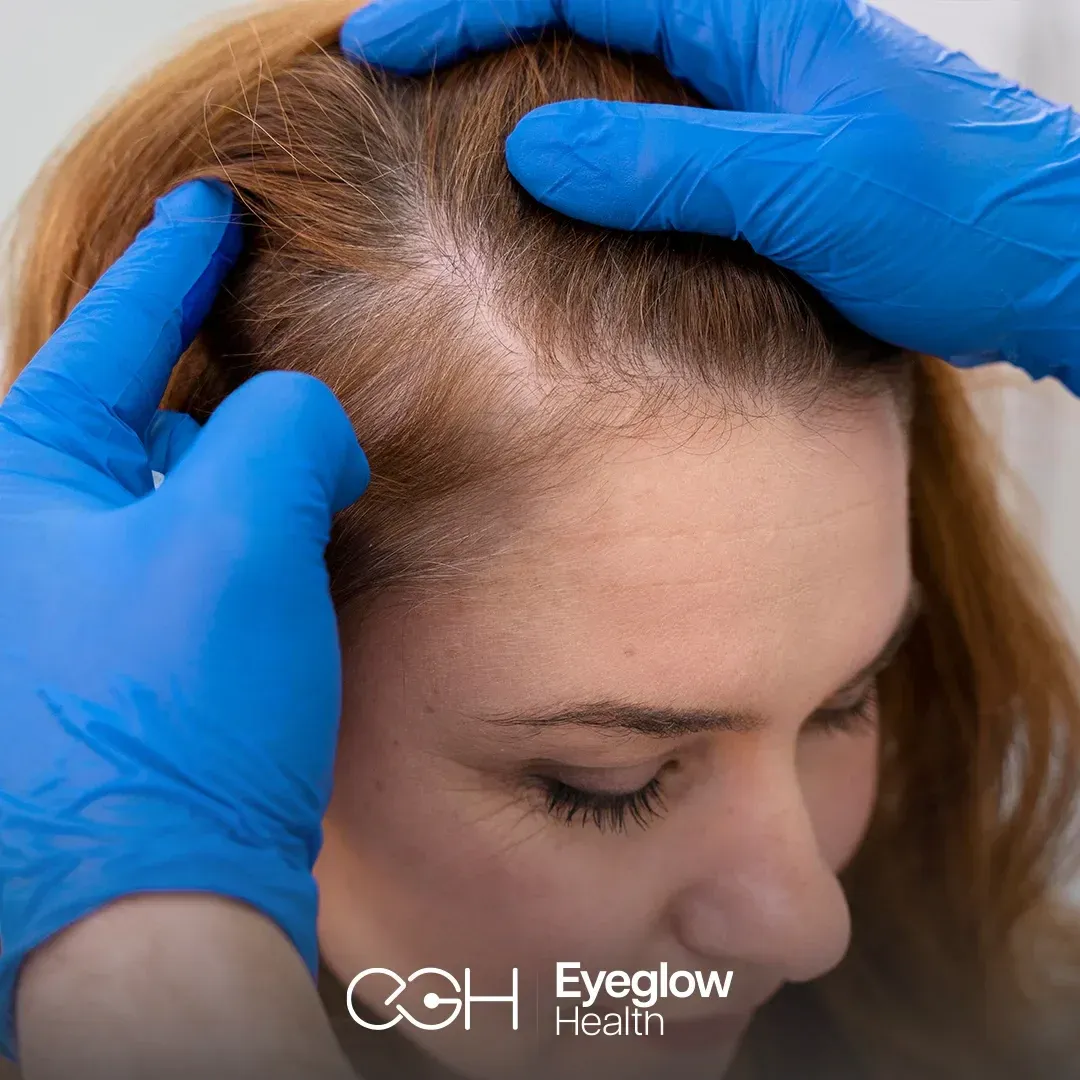
Female hair transplant is a surgical procedure that transfers permanent, DHT-resistant hair follicles from the occipital donor zone to thinned or bald areas — primarily the frontal hairline, temporal recession zones and widening crown part — in women with female pattern hair loss (FPHL) or androgenetic alopecia. Two techniques are used: FUE with sapphire blade (preferred for most cases) and DHI with Choi implanter pen (preferred when an unshaven recipient option is required).
At Eyeglow Health in Istanbul, female hair transplant is coordinated with our partner accredited hair restoration clinic. The operating surgeon is a partner specialist; Eyeglow provides the coordinator, assessment framework and structured aftercare throughout the 12-month follow-up period. We are transparent that Eyeglow is an eye-care specialist clinic — hair restoration is delivered through our accredited partner clinic network with full clinical disclosure.
Female hair loss assessment is fundamentally different from male assessment. A mandatory pre-operative hormonal blood panel (CBC, ferritin, TSH, androgen profile) rules out reversible causes. Trichoscopy of the donor zone confirms whether the occipital band contains stable, non-miniaturised follicles. Approximately one in four women who request a female hair transplant consultation at Eyeglow are directed toward medical optimisation first — surgery on an unstabilised or insufficiently evaluated loss pattern produces inferior and potentially short-lived results. That honest assessment is the foundation of our female consultation process.
From hormonal screening to recovery at home
- 01
Online consultation + hormonal screening checklist
You share four standardised photographs (frontal hairline, top-of-crown, left temporal, right temporal), your hair-loss history, current medications and any available blood test results. Female hair loss has significantly more possible causes than male pattern baldness — hormonal imbalance (PCOS, thyroid, elevated androgens), iron/ferritin deficiency, telogen effluvium and post-menopausal androgenetic alopecia must be assessed before any surgical plan is made. Our hair surgeon reviews your case, determines the likely cause pattern and provides a checklist of pre-operative blood tests required before a graft estimate can be issued.
- 02
Hormonal and medical pre-operative optimisation
Required pre-op blood tests: CBC + ferritin + iron saturation (rule out deficiency anaemia), TSH + free T4 (thyroid function), DHEA-S + testosterone + SHBG (androgen profile), FSH + LH + oestradiol if peri/post-menopausal, prolactin if irregular cycles, INR + hepatitis B/C + HIV per Turkish Ministry of Health protocol. If results indicate reversible or partially reversible hair loss (e.g. low ferritin, undertreated thyroid, early PCOS), medical optimisation (minoxidil 2–5%, spironolactone, iron supplementation, thyroid management) is recommended for 3 to 6 months before surgery to stabilise the loss pattern and maximise donor yield. We are honest that not every woman presenting with diffuse thinning is a transplant candidate: surgery on an unstabilised active loss pattern carries a meaningful risk of continued post-transplant loss of surrounding native hair.
- 03
Pre-operative assessment in Istanbul
Day 1 in Istanbul: trichoscopy (dermoscopy assessment of scalp) + hair pull test + hair density measurement at frontal, temporal, crown and donor zones using a folliscope or digital trichoscope. The donor zone in women is the lower occipital band — typically narrower and less dense than in men, and potentially affected by diffuse thinning. The hair surgeon assesses donor zone miniaturisation under dermoscopy. If the donor zone shows significant miniaturisation (indicating diffuse unpatterned alopecia, DUPA), surgery may not be appropriate regardless of how the frontal zone looks. Hairline design, zone priority mapping and graft count plan are finalised at this visit.
- 04
Technique selection — FUE or DHI (women-specific factors)
FUE with sapphire blade (0.7–0.8 mm punch) is the preferred technique for most female cases: efficient donor area extraction, precise channel creation for dense packing of temporal and frontal zones, and the ability to handle 2,000 to 3,000+ grafts in a single session. DHI (Choi implanter pen) is offered as an alternative when the unshaven recipient option is clinically appropriate — DHI allows the existing hair to remain in place in the recipient zone, so the patient can return to social or professional environments immediately after the procedure. DHI adds surgical complexity when long hair is present in the recipient zone and may increase procedure time. The choice is made case-by-case based on graft count, donor density, patient preference for the recovery period and the surgeon's clinical assessment.
- 05
Procedure day (6–9 hours)
Donor area (lower occipital band) is shaved to a short stubble for graft extraction. If DHI is selected, the recipient zone may remain unshaven for sessions under 2,500 grafts. Local anaesthetic with light intravenous sedation. FUE: sapphire blade micro-punches (0.7–0.8 mm) extract follicular units individually; recipient channels are pre-created with sapphire-tipped blades for precise angle and depth control; grafts placed with forceps. DHI: grafts extracted with micropunches then loaded directly into Choi implanter pens for single-step channel + implantation. Dense packing is prioritised in the frontal hairline and temporal recession zones — the highest-visibility areas in female pattern hair loss (Ludwig I to III).
- 06
Recovery and one-year structured aftercare
Day 1 wash with antiseptic solution at the clinic. Redness and mild swelling for 3 to 7 days. Shock loss (temporary shedding of grafts and surrounding native hair) between weeks 2 and 8 is normal and expected. First new growth at 3 to 4 months; 50–60 percent density by month 6; final result at 12 to 18 months. Minoxidil 2–5% (or 5% if tolerated) and any medically appropriate concurrent medical therapy are continued through the growth phase. Photographic review at 1, 3, 6 and 12 months by video consultation with our hair coordinator.
How Eyeglow coordinates female hair restoration
Eyeglow Health's clinical specialism is eye surgery and vision care — our founding physicians are ophthalmologists. Hair restoration is outside our core surgical specialism. Rather than offering hair transplant under our own roof with a general surgeon, we have built a partner clinic network with accredited hair restoration clinics in Istanbul that hold the Turkish Ministry of Health International Health Tourism Authority Certificate.
For your female hair transplant: the operating surgeon is a partner specialist with documented FUE and DHI volume in female patients specifically. Eyeglow is responsible for your coordinator (single named contact from first message to 12-month review), the assessment framework (hormonal screening protocol, trichoscopy requirements, candidacy criteria), the package structure (transfers, aftercare programme) and your experience in Istanbul. The surgical procedure takes place at the partner clinic with the partner surgical team.
This model is disclosed transparently in every consultation. We believe that specialist surgeons performing procedures in their documented domain — rather than general tourism clinics where the same team operates on eyes, hair and teeth — produce better outcomes for patients.
Female FUE vs DHI vs PRP vs Medical (minoxidil + oral)
The right treatment for female hair loss depends on the cause, the degree of donor zone health, the urgency of restoration and whether the loss is still active or stabilised. Here is how the four main options compare:
| Aspect | FUE (sapphire) | DHI (Choi pen) | PRP + Mesotherapy | Minoxidil + oral medical |
|---|---|---|---|---|
| Technique | FUE — sapphire blade, separate channel + implant | DHI — Choi pen, channel + graft in one motion | PRP + Mesotherapy — injectable, non-surgical | Minoxidil + oral medical — topical/systemic |
| Graft range (women) | 1,500–3,500+ grafts (any size) | 1,500–2,500 grafts (medium sessions) | Not a transplant — no graft extraction | Not a transplant — stimulates existing follicles |
| Unshaven recipient | Limited (partial shaving) | Possible under 2,500 grafts | Always unshaven | Always unshaven |
| Best female indication | Ludwig I–III, temporal recession, frontal thinning | Frontal/temporal with unshaven priority | Early diffuse thinning, post-op adjunct, maintenance | Active loss stabilisation, pre/post-op optimisation |
| Procedure time | 6–9 hours | 7–10 hours | 60–90 minutes (per session) | Ongoing daily/weekly |
| Downtime | 7–10 days crusts | 5–10 days crusts | Same day (mild redness) | None (scalp irritation possible) |
| Permanent result | Yes — transplanted grafts are DHT-resistant | Yes — transplanted grafts are DHT-resistant | No — maintenance sessions needed | No — benefit lost if discontinued |
Personalised pricing
Every treatment plan is priced individually after your consultation. Request a written, all-inclusive quote — clear, itemised, and with no obligation.
Request a written quoteWhat's included in your female hair transplant package
Included in package
- Pre-op consultation + trichoscopy + donor density measurement
- Hair surgeon-led hairline design + zone priority + graft count plan
- Blood tests (CBC, ferritin, TSH, androgen profile, INR, hepatitis B/C, HIV — Turkish Ministry of Health protocol)
- FUE procedure with sapphire blade 0.7–0.8 mm punch + dense packing temporal/frontal OR DHI with Choi pen (technique confirmed at consultation)
- Local anaesthetic + light intravenous sedation
- VIP airport transfers (return)
- All post-op medications + special shampoo + lotion + aftercare kit
- First wash at the clinic + post-op counselling
- 1, 3, 6 and 12-month photographic video follow-up
- Multilingual hair coordinator — 24/7
Paid separately
Items below are not part of the medical package — your coordinator helps you arrange them at no markup.
- Flights to/from Istanbul
- Personal expenses
- Pre-op blood tests (where not performed in Istanbul — many patients obtain these at home before travel)
- Minoxidil 2–5% topical (continued at home — some brands available in Istanbul pharmacy)
- Oral spironolactone or finasteride if prescribed (prescription only)
- PRP / Mesotherapy sessions if added as adjunct (quoted separately)
- Second-session top-up (quoted separately after 12-month review)
- Hormonal or thyroid management (with your local physician)
- Travel insurance (recommended — covers flight cancellation, baggage, non-surgical medical emergencies abroad; we coordinate referral if needed)
Are you a candidate for female hair transplant?
You may be a candidate if
- You have female pattern hair loss (androgenetic alopecia, FPHL) at Ludwig scale I, II or III — stable for at least 12 months with or without medical therapy.
- Your donor zone (lower occipital band) has adequate density without significant miniaturisation confirmed by trichoscopy.
- Pre-operative blood panel shows no active hormonal, nutritional or systemic cause that can be reversed before surgery.
- You want to restore frontal hairline density, address temporal recession or fill in a widening part — the highest-visibility zones in female hair loss.
- You are not pregnant or breastfeeding, and are not planning pregnancy within 12 months of the procedure (hormonal shifts during/after pregnancy affect the result).
Medical optimisation first may be the right step if
- You have diffuse unpatterned alopecia (DUPA) — diffuse thinning throughout the entire scalp including the donor zone. In DUPA the donor area is not a stable source of DHT-resistant grafts; transplanted hair may continue to miniaturise post-surgery. This is the most important contraindication unique to female candidates and it can only be confirmed by trichoscopy in Istanbul.
- You have active hormonal imbalance (untreated PCOS, undertreated thyroid disease, low ferritin) that is driving the hair loss. In this case medical optimisation for 3 to 6 months before reconsidering surgery is the correct sequence — not skipping to transplant.
- You are currently pregnant or breastfeeding — surgery is contraindicated.
- You are in active telogen effluvium (diffuse shedding from a recent trigger — post-partum, crash diet, major illness, surgery). Wait for shedding to stabilise for 6 to 12 months.
- Your hair loss started in the last 6 to 12 months and the progression pattern is not yet clear. Transplanting into an unstabilised loss pattern risks continued thinning of native hair around the transplanted zone.
Disclaimer. Information on this page is consistent with International Society of Hair Restoration Surgery (ISHRS) practice standards, American Hair Loss Association (AHLA) guidelines on female hair loss and Turkish Ministry of Health International Health Tourism Authority Certificate requirements. Candidacy for female hair transplant requires individual trichoscopic and hormonal assessment — this page describes general criteria only. A written graft estimate will not be issued at Eyeglow Health without confirmation of donor zone health and pre-operative blood panel review.
Realistic outcomes — the risks that actually matter in female hair transplant
Female hair transplant has a distinct risk profile from male transplant. We list the female-specific risks here in the same plain language our hair surgeon uses in your consultation:
Donor zone thinning (female-specific)
In female pattern hair loss the donor zone (lower occipital band) is narrower and may itself be affected by diffuse thinning — unlike male pattern baldness where the donor zone is typically stable. Extracting from a thinning donor zone creates visible cosmetic gaps in an area that women often wear down or in a bun. Trichoscopy and dermoscopic miniaturisation assessment of the donor zone is non-negotiable in female consultations. We do not issue a graft estimate until donor zone health is confirmed.
Post-transplant native hair loss
The transplanted grafts are DHT-resistant and will grow permanently. However, surrounding native (non-transplanted) hair may continue to thin in women with active androgenetic alopecia or insufficiently controlled hormonal causes. A successful transplant result at month 12 can be partially offset by continued thinning of untransplanted zones at month 36 to 48. This is why concurrent minoxidil, medical therapy and hormonal management are part of the post-op protocol — not optional extras.
Shock loss of existing hair
Temporary shedding of transplanted grafts and surrounding native hair (shock loss) between weeks 2 and 8 is normal and expected after any hair transplant procedure. For women with diffuse thinning who have limited existing density to begin with, the shock loss phase can be distressing as hair appears thinner than before surgery for a period of 6 to 10 weeks. This resolves as regrowth begins at 3 to 4 months. We describe this process in detail before any procedure is booked so it is not a surprise.
Unshaven DHI complications in longer hair
DHI allows the recipient zone to remain unshaven for sessions under 2,500 grafts, which is socially important for many women. However, existing long hair in the recipient area increases surgical complexity — the surgeon must navigate around existing strands to create channels and implant grafts precisely. This may slightly increase procedure time and graft trauma risk. For sessions over 2,500 grafts, full recipient shaving is recommended to maintain precision. We discuss this honestly so the patient chooses the technique that fits both her clinical picture and her social recovery needs.