
Professional Teeth Whitening in Turkey — In-Office LED + Take-Home Tray at Eyeglow Istanbul
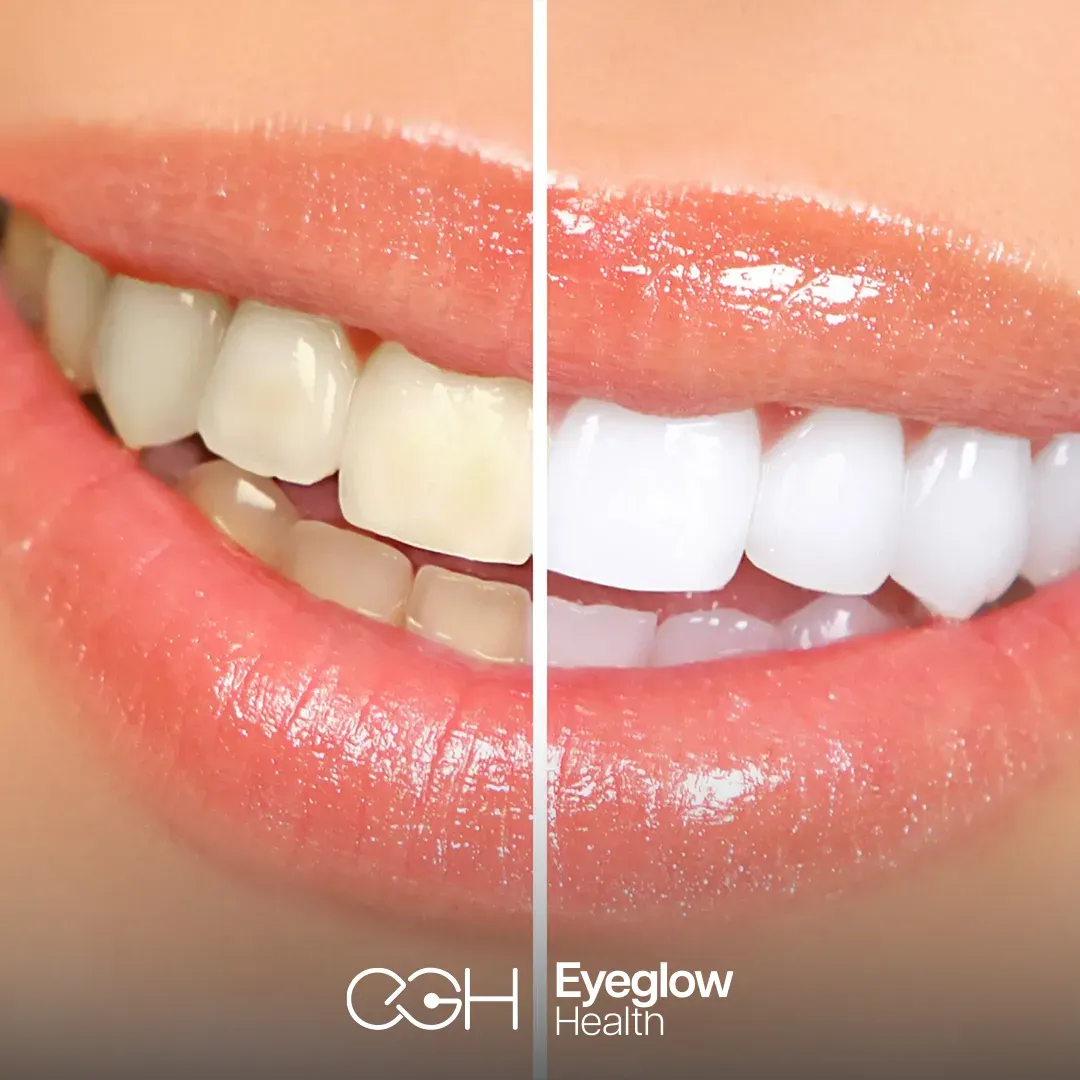
In-office bleaching with 35 to 40 percent hydrogen peroxide gel activated by LED light (Philips Zoom WhiteSpeed, Beyond Polus Advanced, Opalescence Boost) — single 45 to 60 minute session lifts 4 to 8 shades on the Vita Bleached guide. Optional custom take-home tray kit locks in and maintains the result. Delivered at our partner accredited dental clinic by a board-certified dental specialist with mandatory gingival barrier protection.
Verified and listed across leading directories and authorities


What is professional teeth whitening?
Professional teeth whitening is the dental procedure that lightens natural teeth using high-concentration hydrogen peroxide or carbamide peroxide gel. In-office whitening with LED-activated 35 to 40 percent hydrogen peroxide lifts 4 to 8 shades on the Vita Bleached guide in a single 45 to 60 minute session. Take-home tray bleaching uses lower-concentration carbamide peroxide 10 to 16 percent in custom trays worn 30 to 60 minutes daily for 10 to 14 days. Both methods preserve all natural tooth structure — no enamel is removed.
At Eyeglow Health in Istanbul, teeth whitening is delivered at our partner accredited dental clinic by a board-certified dental specialist using American Dental Association (ADA)-recognised systems: Philips Zoom WhiteSpeed, Beyond Polus Advanced, Opalescence Boost or Mectron StarLight Pro. Our protocol includes mandatory pre-bleaching ultrasonic professional cleaning, light-cured resin gingival barrier protection, post-treatment desensitising fluoride application and structured written aftercare. The Turkish Ministry of Health International Health Tourism Authority Certificate is held by both Eyeglow and the partner dental clinic.
Bleaching is the right choice for natural teeth with extrinsic discolouration from coffee, tea, red wine, tobacco or age-related yellowing when the patient does not want shape, length or alignment changes. For severe tetracycline staining, fluorosis, broken anterior teeth or full-smile transformation, veneers or a Hollywood Smile are the smarter routes. That decision belongs to a dental specialist who has examined your teeth, assessed extrinsic versus intrinsic discolouration, and discussed your aesthetic goal — not to a marketing brochure or a price-list page.
From first consultation to long-term maintenance
- 01
Online consultation + shade goal assessment
You share clear intra-oral photographs (front smile, upper and lower arches) and indicate your shade goal. The dental specialist at our partner accredited dental clinic reviews your case, confirms whether teeth whitening is the right indication (versus veneers, crowns or a Hollywood Smile package), and writes a treatment plan that addresses extrinsic versus intrinsic discolouration before any quote is issued.
- 02
Day 1 — clinical examination + professional cleaning
On arrival in Istanbul: clinical oral examination, periodontal screening, recording of baseline shade using the Vita Classical guide and Vita Bleached guide, intra-oral photography under standardised lighting. Mandatory pre-whitening professional cleaning (ultrasonic scaling and selective polishing) removes extrinsic stain, calculus and biofilm — without this step, bleaching only reaches partly-cleaned enamel and the result is uneven and short-lived. Sensitivity assessment using cold thermal test.
- 03
Day 1 — protective barrier placement
The dental specialist isolates the lips and cheeks with a retractor, applies a light-cured resin gingival barrier ("liquid dam") that protects gum tissue from the high-concentration hydrogen peroxide gel, and may apply a desensitising agent (potassium nitrate or fluoride varnish) to teeth at higher sensitivity risk. Pre-treatment patient instructions: avoid hot, cold or acidic foods and drinks for 24 to 48 hours after treatment.
- 04
Day 1 — in-office LED-activated bleaching (45 to 60 minutes)
A 35 to 40 percent hydrogen peroxide gel is applied to the enamel surface in 3 to 4 application cycles of 15 minutes each (total chairside time 45 to 60 minutes). A high-intensity LED light source (Philips Zoom WhiteSpeed, Beyond Polus Advanced, Opalescence Boost chemical activator, or Mectron StarLight Pro) activates and accelerates peroxide breakdown into the active bleaching radicals that diffuse through enamel into dentine. Between cycles the dental specialist removes the spent gel and reapplies fresh material. The patient remains comfortable throughout — the experience is similar to a long dental cleaning.
- 05
Day 1 — final shade recording + sensitivity management
After the final 15-minute cycle the gel is removed, the gingival barrier is peeled off, and final shade is recorded with the Vita Bleached guide and standardised photography. Typical lift is 4 to 8 shades in a single session. Post-treatment fluoride varnish or amorphous calcium phosphate paste (MI Paste / MI Varnish) is applied to reduce transient sensitivity. Standardised "white diet" written instructions are provided: no staining food, drinks or tobacco for 48 hours.
- 06
Day 2 — take-home tray kit (optional) + 12-month aftercare
For patients selecting the in-office + take-home tray package, custom-made bleaching trays are fabricated from digital impressions on Day 1 and delivered Day 2 with 4 to 6 syringes of carbamide peroxide 10 to 16 percent or hydrogen peroxide 4 to 6 percent gel. Take-home protocol: wear trays 30 to 60 minutes daily (carbamide peroxide) or overnight (lower-concentration carbamide) for 10 to 14 days to maximise and lock in the in-office result. Touch-up trays every 12 to 24 months maintain the result long-term. Photographic review at 3, 6 and 12 months by video.
In-office vs Take-home tray vs OTC vs Veneers
The right whitening option depends on your starting shade, aesthetic goal, available time and how much tooth structure you are willing to alter. Here is how the four main approaches differ:
| Aspect | In-office LED | Take-home tray | OTC strips / pens | Veneers |
|---|---|---|---|---|
| Active agent | H2O2 35–40% (chairside) | CP 10–16% or H2O2 4–6% (tray) | H2O2 6–10% strips / pens | Ceramic colour (no bleach) |
| Shade improvement | 4–8 shades single session | 4–8 shades over 10–14 days | 2–4 shades over 4–6 weeks | Unlimited (chosen at fabrication) |
| Treatment time | 45–60 minutes | 10–14 nights at home | 4–6 weeks daily use | 5–7 days (full Hollywood Smile) |
| Permanence of method | Reversible (re-stain possible) | Reversible (re-stain possible) | Reversible | Permanent shape change + colour |
| Best indication | Time-pressed pre-event whitening | Maintenance + slow-and-low | Mild extrinsic staining only | Shape + colour + alignment all wrong |
| Tooth structure altered | No (no enamel removed) | No (no enamel removed) | No (no enamel removed) | Yes (0.3–0.7 mm enamel reduction) |
| Result lasts | 12–36 months lifestyle-dependent | 12–36 months lifestyle-dependent | 6–12 months | 10–15 years (E.max veneers) |
Personalised pricing
Every treatment plan is priced individually after your consultation. Request a written, all-inclusive quote — clear, itemised, and with no obligation.
Request a written quoteWhat's included in your teeth whitening package
Included in package
- Pre-op clinical examination + periodontal screening
- Baseline shade recording (Vita Classical + Vita Bleached guides)
- Standardised intra-oral photography under controlled lighting
- Mandatory pre-whitening ultrasonic scaling and selective polishing
- Light-cured resin gingival barrier ("liquid dam") protection
- In-office LED-activated whitening session (Philips Zoom WhiteSpeed / Beyond Polus / Opalescence Boost)
- 3 to 4 application cycles of 35 to 40 percent hydrogen peroxide gel
- Post-treatment desensitising fluoride varnish or MI Paste / MI Varnish (ACP)
- Written "white diet" 48-hour aftercare instructions in your language
- 5-star hotel — 1 to 2 nights
- VIP airport transfers (return)
- 3, 6 and 12-month photographic video follow-up
- Multilingual dental coordinator — 24/7
- Complication insurance — covers eligible post-operative medical complications during the recovery period at our partner accredited clinic (issued in line with the Turkish Ministry of Health International Health Tourism Authority Certificate)
Paid separately
Items below are not part of the medical package — your coordinator helps you arrange them at no markup.
- Flights to/from Istanbul
- Personal expenses
- Custom take-home tray kit unless the combined in-office + tray package is selected
- Restoration of teeth with white spot lesions, fluorosis or tetracycline staining if veneers are recommended after assessment
- Subsequent maintenance touch-up trays at 12 to 24 month intervals (can be supplied or replenished by your local dentist)
- Travel insurance (flight cancellation, baggage, general trip cover) — separate from the medical complication policy above; your coordinator can recommend a provider at no markup
Are you a candidate for professional whitening?
You may be a good candidate if
- You have natural teeth with mainly extrinsic discolouration from coffee, tea, red wine, tobacco or age-related yellowing — these respond best to professional bleaching.
- You want a brighter smile without changing tooth shape, length or alignment — bleaching preserves all natural tooth structure.
- You have stable periodontal health, no active caries, no untreated cracked teeth, and no severely worn enamel that would expose dentine.
- You understand that ceramic restorations (crowns, veneers, composite fillings) will not lighten with bleaching — these will need replacement to match the new natural shade if they are in the smile zone.
- You have realistic expectations: 4 to 8 shade improvement (Vita Bleached scale) is the typical outcome — not a uniform brilliant-white film-star result, which requires veneers.
Another option may be smarter if
- You have severe tetracycline staining or fluorosis — these intrinsic discolourations respond poorly to bleaching and usually require veneers.
- You have severe sensitivity, exposed root surfaces or untreated cracked teeth — bleaching will exacerbate sensitivity and may damage compromised teeth.
- You are pregnant or breastfeeding — the American Dental Association recommends deferring elective bleaching during pregnancy and lactation as a precaution (no documented harm but no safety benefit either).
- You have crowns or veneers in the smile zone that you do not wish to replace — bleaching the natural teeth around them will create an obvious shade mismatch.
- You expect the result to last permanently — natural teeth re-stain over 12 to 36 months from lifestyle factors and maintenance touch-up is required for long-term satisfaction.
Disclaimer. Information on this page is consistent with American Dental Association (ADA) clinical guidance, FDI World Dental Federation standards, European Council Directive 2011/84/EU on tooth whitening peroxide concentrations and Turkish Ministry of Health International Health Tourism Authority Certificate requirements. The choice between in-office whitening, take-home tray, over-the-counter strips or veneer-based shade change is a case-by-case clinical and aesthetic decision based on intrinsic versus extrinsic staining, sensitivity profile and aesthetic goal — not a marketing-driven default.
Realistic outcomes — the risks that actually matter
Every cosmetic dental procedure has measurable risks. We list them here in the same plain language our dental specialist uses in your consultation:
Transient tooth sensitivity
Mild to moderate thermal sensitivity ("bleaching sensitivity") affects 30 to 60 percent of patients during and 24 to 48 hours after in-office whitening. This is caused by reversible peroxide diffusion through the dentinal tubules and almost always resolves within 48 hours. Managed by pre-treatment desensitising agents (potassium nitrate, fluoride varnish, MI Paste / MI Varnish), avoidance of hot or cold foods for 48 hours after treatment, and a one-day pause from take-home trays if sensitivity becomes uncomfortable. Severe persistent sensitivity beyond 7 days is unusual and warrants a telehealth review.
Gingival irritation or chemical burn
High-concentration hydrogen peroxide is caustic to soft tissue. The light-cured resin gingival barrier ("liquid dam") prevents direct gel contact with gum tissue — its placement is mandatory in our protocol. Brief contact during gel application may cause transient white spots on the gum margin that fade within 24 to 48 hours without long-term damage. Take-home tray patients are instructed to wipe excess gel from the gumline after tray insertion to prevent gingival irritation from prolonged contact.
Uneven or relapse colour change
Natural teeth bleach faster on the labial surface than at the cervical (gumline) area; canine teeth typically have more chroma than incisors and may not lighten as much; rotated teeth may show uneven exposure to the LED light. Initial result may show slight non-uniformity for 7 to 14 days, then settles. Long-term, natural teeth re-stain from lifestyle factors (coffee, tea, red wine, tobacco, certain mouth rinses) over 12 to 36 months — maintenance touch-ups every 12 to 24 months are required for long-term satisfaction. We are honest about this in consultation: bleaching is not a permanent procedure.
No effect on existing restorations
Hydrogen peroxide does not lighten ceramic crowns, porcelain veneers, composite fillings or amalgam restorations — these will retain their original shade while natural teeth lighten around them. If you have anterior crowns or veneers in the smile zone, post-bleaching shade mismatch will be obvious — they must be replaced after bleaching to match the new natural shade. We discuss this pre-treatment so you can decide whether to bleach (then replace restorations) or proceed to a Hollywood Smile makeover directly.