
Eyebrow Transplant in Turkey — Permanent Real-Hair Brow Restoration at Eyeglow Istanbul
Surgical eyebrow restoration using FUE or DHI harvesting from the scalp donor area and single-hair graft implantation at the flat angle eyebrow hair grows. A permanent real-hair alternative to microblading and brow tattoo — for over-plucked, post-traumatic, alopecia-affected or sparse brows. Performed at our partner accredited hair clinic by a hair restoration surgeon with documented eyebrow case volume.
Verified and listed across leading directories and authorities


What is an eyebrow transplant?
An eyebrow transplant is a surgical procedure that harvests single-hair follicular units from the donor area of your scalp using FUE or DHI micropunches, then implants them one by one into the eyebrow zone at the flat 5 to 10 degree angle eyebrow hair grows. Only single-hair grafts are used (multi-hair grafts look unnaturally tufted on the brow). Typical graft count 150 to 400 per eyebrow, with final outline visible at month 6 to 9 — a permanent real-hair alternative to microblading and brow tattoo.
At Eyeglow Health in Istanbul, your eyebrow transplant is performed at our partner accredited hair clinic by a hair restoration surgeon with documented eyebrow transplant volume of 100+ cases — a specific case profile that matters because brow outline design and the very flat 5 to 10 degree implantation angle require dedicated experience separate from general scalp transplant volume. The Turkish Ministry of Health International Health Tourism Authority Certificate is held by both Eyeglow and the partner clinic. We follow International Society of Hair Restoration Surgery (ISHRS) sub-specialty standards for facial hair restoration.
Eyebrow transplant is the right choice if you have sparse, asymmetric, over-plucked or essentially-bare brows you want restored with real hair, if you have a scar across your brow preventing natural growth, or if you have stable alopecia areata affecting brow hair. The honest caveat: because the donor follicles came from your scalp, they grow faster and longer than native brow hair — ongoing trimming every 2 to 4 weeks is required for the rest of your life. We teach the trimming routine at the 6-month review. Patients who cannot commit to trimming should consider microblading as a maintenance-light alternative.
From first consultation to final brow outline
- 01
Online consultation + photo assessment
You share four standardised photographs of your eyebrows (front, left, right, close-up) and explain whether you want a complete rebuild, partial fill-in or scar coverage. Our hair surgeon assesses the existing follicle pattern, donor scalp density and the target outline. A written graft estimate is provided before any quote is issued.
- 02
Pre-operative outline drawing
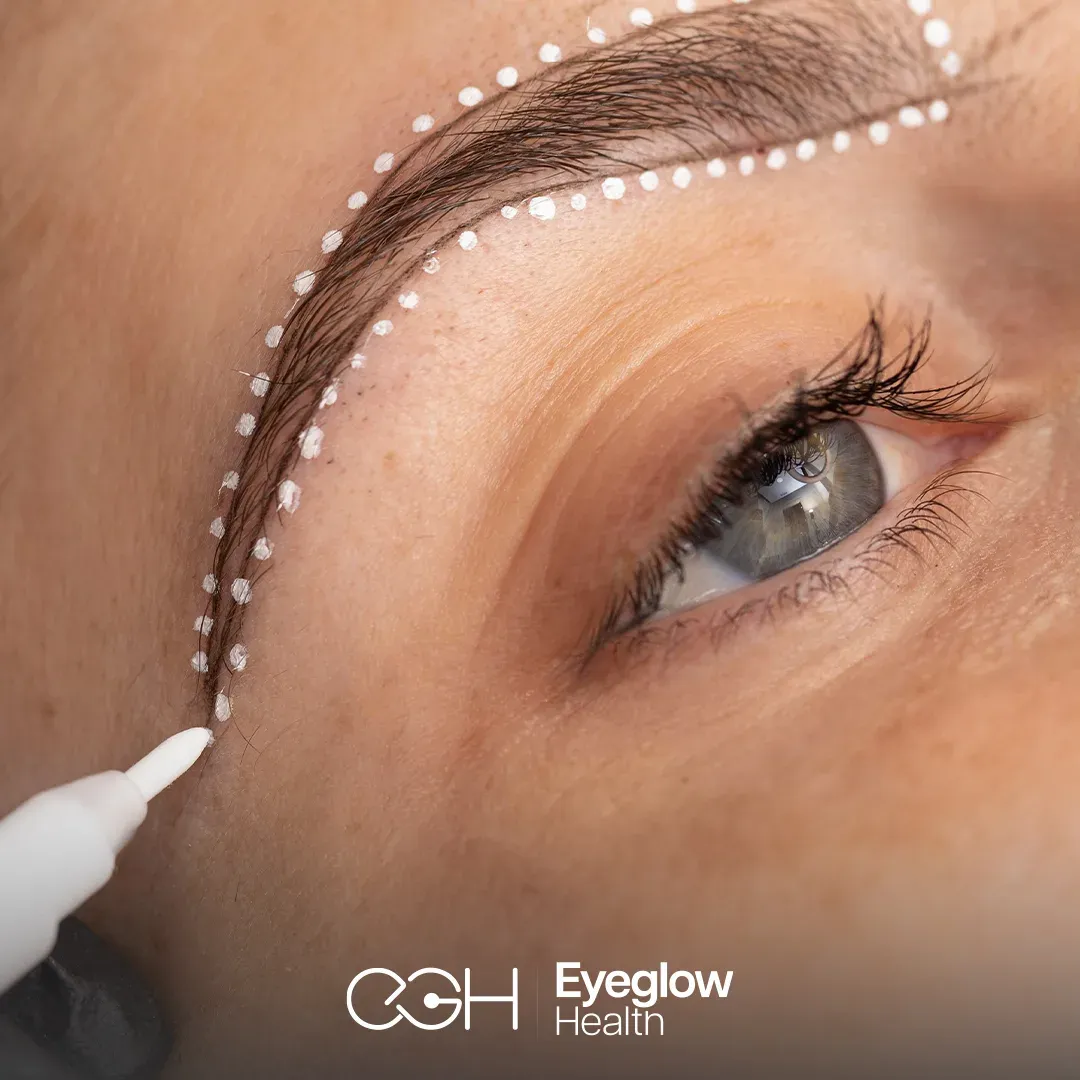
On day 1: detailed brow outline is drawn with cosmetic pencil while you sit upright in front of a mirror. The shape follows your facial structure (brow bone position, eye spacing, cheekbone curve) — not a fashion-trend template. You see the outline, approve it, and only then is the photograph taken that the surgical team works from. Blood tests follow per Turkish Ministry of Health protocol.
- 03
Donor harvest from scalp
A small zone of the occipital scalp is shaved short. The hair surgeon harvests 300 to 800 follicular units (depending on whether one or both brows are being treated) using 0.6 to 0.8 mm FUE micropunches. Microscope-assisted slivering separates each unit into the single-hair grafts that eyebrow work requires — multi-hair grafts look unnaturally tufted on the brow.
- 04
Implantation at flat 5–10 degree angle
Recipient channels are created with fine 0.6 mm needles or implanter pens at the precise flat angle eyebrow hair grows (5 to 10 degrees against the skin — far flatter than scalp angle, even flatter than beard angle). Each single-hair graft is placed individually following the natural growth direction of the brow: head-to-tail flow at the inner third, slight downward curve at the arch, lateral curve at the tail. The recipient zone is not shaved.
- 05
Day 1 wash + week 1 review
First wash with antiseptic solution at the clinic on day 1. Small crusts directly on the brow for 7 to 10 days; mild brow-region swelling for 2 to 4 days. The transplanted hairs typically shed between weeks 2 and 6 (shock loss — normal and expected). Brief bare period from week 2 to month 2 before regrowth begins. Eye make-up is avoided for 14 days; brow brushing for 30 days.
- 06
Six- to nine-month structured aftercare
1, 3, 6 and 9-month photographic reviews. First new growth visible at month 3 to 4; final outline at month 6 to 9. Trimming required ongoing — because the donor follicles came from your scalp they grow faster and longer than native eyebrow hair, so you trim every 2 to 4 weeks with small scissors to maintain a natural brow length. We teach the trimming routine at the 6-month review.
Eyebrow transplant vs Microblading vs Brow tattoo vs no treatment
The right option for sparse or bare brows depends on whether you want real hair (transplant) or surface pigment (microblading / tattoo). Here is how the options compare:
| Aspect | Eyebrow Transplant | Microblading | Brow Tattoo | No treatment |
|---|---|---|---|---|
| Outcome type | Permanent surgical restoration | Semi-permanent pigment in skin (1–3 years) | Permanent ink tattoo in skin | No change — sparse or absent brow remains |
| Best for | Post-traumatic gap, over-plucked, alopecia, scar coverage | Density boost on existing brow, no real hair desired | Permanent pigment when no hair growth possible | — |
| Result texture | Real hair you can brush and shape | 2D drawn-on lines (not 3D hair) | 2D ink (often fades to grey/blue) | — |
| Maintenance | Trim every 2–4 weeks (no touch-ups) | Re-touch every 12–18 months | Permanent — colour drift over 5–10 years | — |
| Procedure time | 3–5 hours | 2 sessions × 90 minutes | 60–90 minutes | — |
| Recovery time | 7–10 days crusts | 5–7 days flaking | 5–7 days flaking | — |
| Price relative (one-off) | High (one-time investment) | Low per session, recurring cost | Low one-off, removal costly if regretted | — |
Personalised pricing
Every treatment plan is priced individually after your consultation. Request a written, all-inclusive quote — clear, itemised, and with no obligation.
Request a written quoteWhat's included in your eyebrow transplant package
Included in package
- Pre-op consultation + scalp donor examination + brow outline drawing
- Hair surgeon-led brow outline design (drawn with patient seated upright in mirror, signed off pre-operatively)
- Blood tests (CBC, INR, hepatitis B/C, HIV — Turkish Ministry of Health protocol)
- FUE donor harvest from scalp + single-hair graft implantation at 5–10 degree flat angle
- Local anaesthetic + light intravenous sedation
- 5-star hotel — 3 nights
- VIP airport transfers (return)
- All post-op medications + special facial wash + aftercare kit
- First wash at the clinic + post-op counselling (eye make-up and brow brushing guidance)
- 1, 3, 6 and 9-month photographic video follow-up + brow-trimming routine teaching
- Multilingual hair coordinator — 24/7
- Complication insurance — covers eligible post-operative medical complications during the recovery period at our partner accredited clinic (issued in line with the Turkish Ministry of Health International Health Tourism Authority Certificate)
Paid separately
Items below are not part of the medical package — your coordinator helps you arrange them at no markup.
- Flights to/from Istanbul
- Personal expenses
- Existing microblading or brow tattoo removal (laser) if requested before transplant
- Second-session top-up for density (quoted separately after 9-month review)
- Unrelated medical treatments
- Travel insurance (flight cancellation, baggage, general trip cover) — separate from the medical complication policy above; your coordinator can recommend a provider at no markup
Are you a candidate for an eyebrow transplant?
You may be a good candidate if
- You have sparse, asymmetric, over-plucked or essentially-bare eyebrows you want surgically restored with real hair (not pigment).
- You have a scar across your brow (post-traumatic, post-surgical, burn) preventing natural hair growth in part of the brow line.
- You have stable alopecia areata or alopecia universalis affecting eyebrow hair (medical clearance from your dermatologist required for active autoimmune disease).
- You are tired of microblading touch-ups every 12 to 18 months and want a permanent real-hair alternative.
- You accept the ongoing trimming requirement (transplanted brows grow faster than native and need scissor-trimming every 2 to 4 weeks).
Another option may be smarter if
- You have active alopecia areata flare on the brows — wait for 12+ months of stability before surgery.
- You have unrealistic expectations about a "fashion-trend brow shape" — outline must follow your natural facial structure to look natural.
- You cannot commit to the trimming routine — un-trimmed transplanted brows grow several centimetres long over months and look unnatural.
- You want zero downtime — facial crusts on the brow are visible for 7 to 14 days; this is not a same-day cosmetic procedure.
Disclaimer. Information on this page is consistent with International Society of Hair Restoration Surgery (ISHRS) facial-hair restoration sub-specialty standards, American Hair Loss Association (AHLA) guidance and Turkish Ministry of Health International Health Tourism Authority Certificate requirements. Brow outline design and graft count are case-by-case clinical decisions made by the hair surgeon after examining your donor scalp and the recipient brow zone in front of a mirror — not generic fashion templates.
Realistic outcomes — the risks that actually matter
Every facial-hair surgery has measurable risks. We list them here in the same plain language our hair surgeon uses in your consultation:
Shock loss + temporary bare period (weeks 2–8)
Transplanted hairs typically shed between week 2 and week 6 — this is normal and expected (the follicle survives, the existing hair shaft is released). Brief bare period from week 2 to month 2 before regrowth begins. Some surrounding native brow hair may also shed temporarily from procedural inflammation; it grows back. Permanent loss of native brow hair is rare with experienced surgeons.
Angle or direction mismatch (rare with experienced surgeon)
Eyebrow hair grows at a 5 to 10 degree flat angle — even flatter than beard hair, far flatter than scalp. An inexperienced surgeon implanting at scalp or beard angle produces a perpendicular tufted brow that looks unnatural. Inner-third grafts must flow head-to-tail; arch grafts curve slightly downward; tail grafts curve laterally. We work only with hair surgeons who have documented eyebrow transplant volume of 100+ cases. Angle errors generally cannot be corrected by trimming alone.
Ongoing trimming requirement
Because the donor follicles came from your scalp, they retain their original growth speed — typically 1 cm per month, far faster than native brow hair (which grows ~0.16 mm per day and self-limits at a short length). You must trim the transplanted brow every 2 to 4 weeks with small scissors. We teach the trimming routine at the 6-month review. Untrimmed transplanted brows grow several centimetres long over months and look unnatural — patients who cannot commit to trimming should reconsider whether the procedure is right for them.
Density-below-expectation
Eyebrow transplant produces a natural full brow, not the extreme fluffy density of an Instagram-filtered fashion brow. If your reference photo is of someone with naturally extreme brow density, manage expectations: 200 to 250 grafts per brow gives a natural mature-brow look. A second session at month 9 can add density if you want a fuller look, but transplanting more than 400 grafts into a single brow at one session is generally avoided to protect graft survival in the small recipient zone.