
All-on-4 Dental Implants in Turkey — Full-Arch Fixed Teeth in 24 Hours at Eyeglow Istanbul
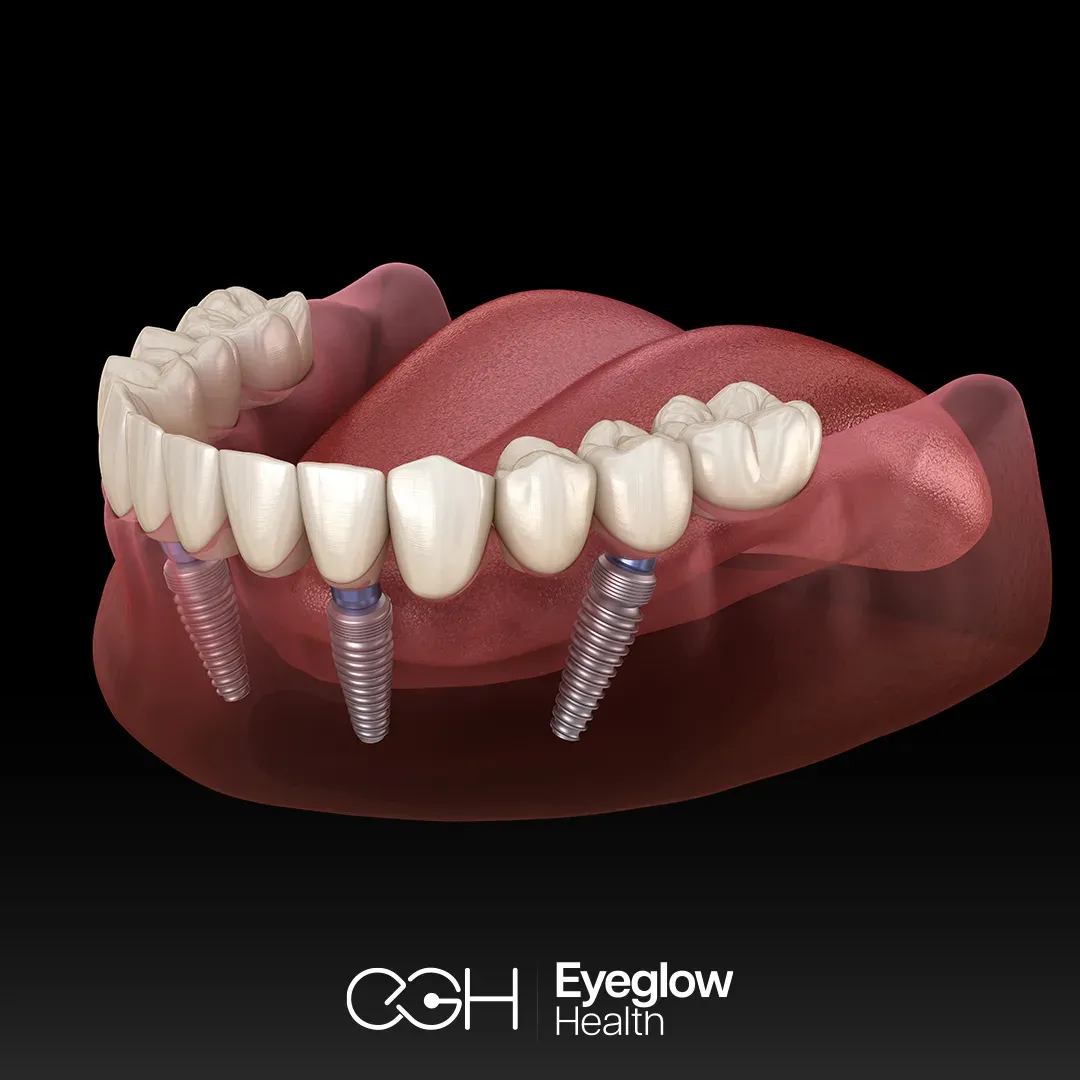
All-on-4 is the full-arch fixed-bridge protocol developed by Paulo Maló and Nobel Biocare in 1998 — 4 implants per jaw (2 anterior vertical plus 2 posterior tilted at 30 to 45 degrees) support a complete set of fixed teeth. A temporary acrylic bridge is fitted within 24 hours of surgery; the final monolithic zirconia bridge follows 3 to 6 months later. Most edentulous cases avoid bone grafting. Delivered at our partner accredited dental clinic by a DDS board-certified dental specialist.
Verified and listed across leading directories and authorities


What are All-on-4 dental implants?
All-on-4 is a full-arch fixed dental-bridge protocol that supports a complete set of teeth — typically 10 to 14 teeth — on just 4 dental implants per jaw. The 2 anterior implants are placed vertically; the 2 posterior implants are tilted at 30 to 45 degrees to engage dense anterior bone and avoid the sinus and inferior alveolar nerve. A temporary fixed acrylic bridge is fitted within 24 hours ("teeth in a day"); the final monolithic zirconia bridge follows 3 to 6 months later.
At Eyeglow Health in Istanbul, All-on-4 is performed at our partner accredited dental clinic by a DDS board-certified dental specialist using original Nobel Biocare, Straumann or Mega Gen implants — the same brands used in implant clinics across Switzerland, Sweden and Germany. The Turkish Ministry of Health International Health Tourism Authority Certificate is held by both Eyeglow and the partner dental clinic. We follow American Dental Association (ADA) implant guidelines and FDI World Dental Federation standards on the original Maló protocol (Maló 2003 — Clinical Implant Dentistry and Related Research; Maló 2012; Maló 2018).
All-on-4 is the right protocol for edentulous patients (or those with failing remaining teeth) who want fixed (not removable) teeth, who want to avoid bone grafting where possible, and who can commit to two visits to Istanbul separated by 3 to 6 months. The decision between All-on-4, All-on-6 or conventional implant rehabilitation belongs to a DDS who has personally reviewed your CBCT scan and discussed your priorities.
From first consultation to final zirconia bridge
- 01
Online consultation + CBCT review
You share a panoramic X-ray or 3D cone-beam CT (CBCT) plus a brief dental history. Our partner DDS reviews bone volume in the anterior (front) jaw, identifies whether All-on-4 is feasible without bone grafting (yes in most edentulous cases), confirms candidacy and selects implant dimensions. A written treatment plan with itemised pricing is sent before any payment is requested.
- 02
Pre-operative assessment in Istanbul
On day 1 in Istanbul: clinical examination, fresh CBCT if needed, full-mouth digital scan, blood tests (CBC, INR, hepatitis B/C, HIV per Turkish Ministry of Health protocol), informed consent. If you still have failing remaining teeth, these are atraumatically extracted at this visit or in combination with implant surgery. Digital implant planning is finalised on a surgical guide.
- 03
All-on-4 implant surgery (3 to 5 hours per arch)
Under local anaesthetic and intravenous sedation, 4 implants are placed per arch: 2 in the anterior jaw (vertical, between the natural canine positions) and 2 in the posterior jaw (tilted at 30 to 45 degrees to avoid the sinus on the upper jaw and the inferior alveolar nerve on the lower jaw). The tilted-implant biomechanical principle was developed by Paulo Maló and Nobel Biocare in 1998 and allows full-arch rehabilitation without bone grafting in most edentulous cases.
- 04
Same-day temporary bridge fitted ("teeth in a day")
On the same surgical day or within 24 hours, a fixed temporary acrylic bridge is screwed onto multi-unit abutments connected to the 4 implants. You leave the clinic with a full set of fixed temporary teeth on each treated arch — no removable denture, no toothless period. The temporary bridge is functional for soft to medium foods immediately; gradual food re-introduction is guided over 3 to 6 months while bone integration completes.
- 05
Healing + osseointegration (3 to 6 months)
You return home with the temporary bridge in place, antibiotics, anti-inflammatory and oral-rinse instructions. During this period the 4 implants fuse biologically with the surrounding bone. Eyeglow coordinator schedules a remote 1-month and 3-month review by photo and video; any soreness or bite issue is addressed by the partner DDS through the coordinator without delay.
- 06
Final zirconia bridge delivery (visit 2)
You return to Istanbul after osseointegration is confirmed by CBCT. The temporary acrylic bridge is removed, multi-unit abutments are checked, a final digital scan is taken and the partner laboratory crafts a monolithic zirconia bridge (or zirconia with porcelain layering on the front teeth) over 4 to 6 working days. The final bridge is screw-retained for serviceability and can be unscrewed by your home dentist for cleaning every 1 to 2 years.
All-on-4 vs conventional implants vs dentures vs All-on-6
For patients missing most or all of their teeth, the right full-arch protocol depends on bone volume, bite force, budget and willingness to commit to implant maintenance. Here is how the four main options compare:
| Aspect | All-on-4 | Conventional implants | Denture | All-on-6 |
|---|---|---|---|---|
| Implants per arch | 4 (2 vertical + 2 tilted) | 6 to 10 per arch (one per missing tooth area) | 0 (gum-supported) | 6 per arch |
| Bone graft needed | No in most cases (tilted implants avoid sinus / nerve) | Yes in 60–80% of cases | No | Sometimes (depends on posterior bone) |
| Time to fixed teeth | Same day (24 hours) | 3–6 months minimum | Same day (but removable) | Same day (24 hours) |
| Long-term cost | Lower (fewer implants) | Higher (more implants + grafts) | Lower upfront, higher long-term | Slightly higher than All-on-4 |
| Maintenance | Interdental brush + water flosser daily | Same as natural teeth + special floss | Remove + clean nightly | Interdental brush + water flosser daily |
| Bite force | Strong (~80% of natural teeth) | Excellent (~90% of natural teeth) | Reduced (~30% of natural teeth) | Slightly stronger than All-on-4 |
Personalised pricing
Every treatment plan is priced individually after your consultation. Request a written, all-inclusive quote — clear, itemised, and with no obligation.
Request a written quoteWhat's included in your All-on-4 package
Included in package
- Pre-op consultation + clinical examination + CBCT review
- Implant-planning software analysis + surgical guide where indicated
- Atraumatic extraction of any remaining failing teeth (if needed) on the surgical day
- Blood tests (CBC, INR, hepatitis B/C, HIV — Turkish Ministry of Health protocol)
- All-on-4 implant placement at partner accredited dental clinic by DDS board-certified dental specialist
- Local anaesthetic + intravenous sedation included
- 4 dental implants per arch (Mega Gen standard / Straumann or Nobel Biocare on premium tier)
- Multi-unit abutments + same-day fixed acrylic temporary bridge
- 5-star hotel — 4 nights surgical visit + 5 nights final-bridge visit
- VIP airport transfers (return) for both visits
- All post-op medications + antibiotics + oral-rinse + soft-diet aftercare kit
- Final monolithic zirconia bridge (or zirconia with porcelain front-teeth layering on premium tier)
- 1, 3, 6 and 12-month photographic video follow-up
- Implant manufacturer warranty documentation
- Multilingual dental coordinator — 24/7
- Complication insurance — covers eligible post-operative medical complications during the recovery period at our partner accredited clinic (issued in line with the Turkish Ministry of Health International Health Tourism Authority Certificate)
Paid separately
Items below are not part of the medical package — your coordinator helps you arrange them at no markup.
- Flights to/from Istanbul (two visits required)
- Personal expenses
- Bone grafting or sinus lift if needed (a separate quote is provided at consultation; All-on-4 typically avoids bone grafting but a small proportion of cases still need it)
- Replacement final bridge if the original needs replacement after 10+ years (warranty covers the implant fixtures, not the bridge superstructure beyond standard warranty period)
- Treatment of remaining natural teeth on the opposite arch (separate dental plan if needed)
- Travel insurance (flight cancellation, baggage, general trip cover) — separate from the medical complication policy above; your coordinator can recommend a provider at no markup
Are you a candidate for All-on-4 dental implants?
You may be a good candidate if
- You are missing most or all of the teeth in one or both jaws — or your remaining teeth are failing and need extraction.
- You have adequate anterior (front) jawbone volume — All-on-4 needs minimum 5 mm bone height in the front jaw; tilted posterior implants avoid sinus and nerve constraints.
- You are a non-smoker or willing to stop from 2 weeks before surgery to 3 months after — nicotine reduces osseointegration in all implant cases.
- You can commit to two visits to Istanbul (4 to 5 nights surgical visit + 5 nights for the final bridge) separated by 3 to 6 months.
- You want fixed (not removable) teeth and understand the maintenance requirement is daily interdental brushing plus 6-monthly hygiene visits.
A different approach may suit you better if
- You have uncontrolled diabetes (HbA1c above 8%) or active oral infection — these must be stabilised first.
- You are taking high-dose intravenous bisphosphonates (osteoporosis medication) — osteonecrosis risk is elevated; a removable denture may be safer.
- You have had radiotherapy to the head and neck within the last 12 months — implant healing in irradiated bone is significantly impaired.
- You only have 1 to 3 missing teeth — individual implants or a fixed bridge are more conservative; All-on-4 is not appropriate when most natural teeth are healthy.
- You are unable or unwilling to maintain daily interdental cleaning — peri-implantitis around full-arch bridges is particularly damaging and difficult to treat.
Disclaimer. Information on this page is consistent with American Dental Association (ADA) implant guidelines, FDI World Dental Federation standards and Turkish Ministry of Health International Health Tourism Authority Certificate requirements. The choice between All-on-4, All-on-6 or conventional implant rehabilitation is a clinical decision based on bone volume, bite force, edentulous timeline and patient priorities — not a marketing-driven default.
Realistic outcomes — the risks that actually matter
Every All-on-4 procedure has measurable risks. We list them here in the same plain language our DDS uses in your consultation:
Implant failure in the first 6 to 12 months
Individual All-on-4 implants fail to integrate in approximately 2 to 5% of cases over the first year, similar to single-tooth implants. When one of the 4 implants fails, the temporary bridge is removed, the failing implant is replaced (often with a slightly larger fixture in the same position), and healing restarts. The other 3 implants usually continue to integrate normally. Eyeglow coordinator manages return travel logistics under warranty.
Prosthetic complications (more common than implant failure)
In long-term All-on-4 follow-up studies (Maló 2012, Maló 2014), implant survival exceeds 95% at 10 years — but prosthetic complications (acrylic temporary fracture, abutment screw loosening, opposing-arch wear) occur in 20 to 40% of cases over 10 years. These are correctable in-chair at modest cost and do not threaten the implants themselves. Annual professional review with a dentist trained in implant prosthetics is essential.
Nerve injury (lower jaw)
The inferior alveolar nerve runs through the lower jaw and supplies sensation to the lip and chin. The posterior tilted implants in lower All-on-4 must avoid this nerve. CBCT 3D planning and surgical guide use reduce the risk of permanent nerve injury to under 1%; transient numbness for a few weeks is reported in 2 to 3% of cases and almost always resolves. We perform 3D digital planning on every All-on-4 lower-jaw case.
Hygiene-related peri-implantitis (long-term)
Bacterial inflammation around full-arch bridge implants is particularly destructive because all 4 implants must support the same bridge — if peri-implantitis affects one or two implants, the entire bridge may need to come off for treatment. Daily interdental brushing, water flossing under the bridge and 6-monthly professional cleaning are non-negotiable for All-on-4 patients. We discuss this at length in consultation and provide a written aftercare protocol.